Skip to content
Attack! (Aldrich, 1956)

Attack! (1956)

The following was written for a graduate seminar on Cold War military history. It examines the confluence of social, political, and economic events that allowed the financing and production of such an ambivalent anti-war film in Eisenhower America.

Eyes Wide Shut (Kubrick, 1999)

Eyes Wide Shut (1999)

  • by

The following was written for a graduate seminar on James Joyce and W.B. Yeats. Please forgive the fumbling psycho-babble. I think it actually serves a very legitimate reading of this film.

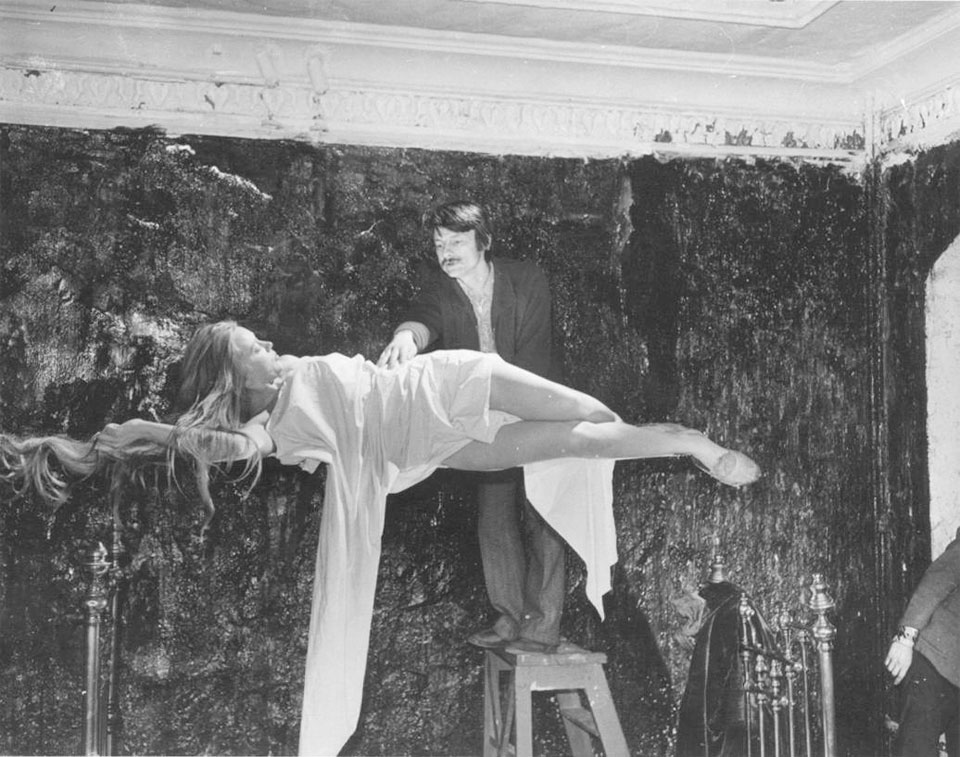
Tarkovsky filming a scene from MIRROR

Sculpting in Time

I’ve never read another book like Sculpting in Time. In it Tarkovsky speaks as eloquently about art as he does faith and philosophy, and does so in a remarkably kind, concerned voice.

Sculpting in Time (1987)

I’ve never read another book like Sculpting in Time. In it Tarkovsky speaks as eloquently about art as he does faith and philosophy, and does so in a remarkably kind, concerned voice. To him, his subject —the unique ability of the cinematic image to touch the soul and inspire spiritual improvement — is quite literally a matter of life and death.

New Seeds of Contemplation (1961)

Like “Making Peace,” the Denise Levertov poem that inspired this site, Thomas Merton’s New Seeds of Contemplation is concerned with the destructive influences of greed, superficiality, and passivity on our hectic, disjointed lives.

Double Lives, Second Chances: The Cinema of Krzysztof Kieslowski (1999)

Insdorf sets out with the right questions in mind: How was Kieslowski’s body of work shaped by personal experience, particularly by his life under Communism? What other directors, artists, and thinkers shaped his aesthetic? What preoccupations, both ideological and stylistic, form the backbone of his work? What precipitated his move from documentary to narrative film, and how did each influence the other? Unfortunately, in attempting to answer all of these questions (and in only 180 pages), she fails to address any of them adequately.

Buried Child (1978)

With his return, Vince takes on his legacy, the house itself and the secrets buried around and within it. He also takes on its pain.

The Basic Training of Pavlo Hummel (1971)

As is the case when I watch Full Metal Jacket, I find Pavlo Hummel much more interesting when viewed in this light—as an examination of “the eternal human pageant,” that constant process of interaction, performance, and construction.

Angels in America: Millennium Approaches (1992)

Note: These are my initial thoughts on Millennium Approaches, written as a journal assignment in the fall of 1998. I’m tempted to revise it or pull it down altogether, but I’ve decided to keep it up here as an artifact of sorts.

July’s People (1981)

Note: The following was written for a graduate seminar on Postcolonial literature, but, aside from the first few paragraphs, it is a fairly straight-forward reading of what might just be my favorite novel.

Fefu and Her Friends (1977)

To be quite honest, I don’t get Fornes’s play. But in this case (as opposed to a few other works I’ve read which have left me similarly perplexed), I feel somewhat driven to figure it out. I’ve decided to begin with the first clue Fornes gives us, the title. Following are my general impressions of Fefu and her friends:

Man of Mode (1676)

In the third act of Etherege’s The Man of Mode, Young Bellair is surprised to learn that Harriet has as little interest in him (her intended husband) as he has in her. “‘Tis not unnatural for you women to be a little angry, you miss a conquest,” Bellair says, “though you would slight the poor man were he in power.” His comment acknowledges a gender-based power struggle that drives much of the action in Restoration comedy.

Nervous Conditions (1988)

The other snapshots of religion offered in Nervous Conditions are equally disturbing. Through Tambu we see a child’s image of God. She speaks of being caned on Monday mornings for not attending the previous day’s Sunday School class. She waits in line as she and the other Africans are inspected for missing buttons and dirty socks. She sees her beloved uncle chastise his daughter for the embarrassment she causes him at church. And worst of all, she accepts it.

In the Time of Butterflies (1994)

“Why, they inevitably ask in one form or another, why are you the one who survived?” (page 5). Before meeting the sisters of In the Time of Butterflies, before even learning their names, we know that they have lived lives and died deaths worth telling.