Pile
I’m not a slob. Really. Which is why I grabbed my camera this morning. I wish I could say that I had doctored this photo or had carefully arranged my bedside table for dramatic effect, but this is what I woke up to. Sad but true.
I’m not a slob. Really. Which is why I grabbed my camera this morning. I wish I could say that I had doctored this photo or had carefully arranged my bedside table for dramatic effect, but this is what I woke up to. Sad but true.
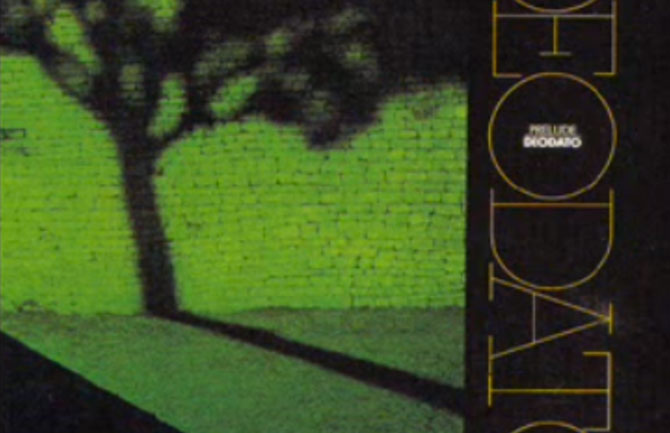
I only know of Deodato because of Being There (1979). Hal Ashby drops his needle on “Zarathustra” during the long sequence near the beginning of the film when Chance leaves his now-dead employer’s estate and wanders, umbrella and suitcase in hand, through the streets of Washington, D.C.
I had my first TIFF-related dream last night. It was kind of like that dream where you show up for a final exam after skipping class all semester, except that, instead of sliding into a strange classroom, I was wandering around Toronto with no tickets because I’d forgotten to submit my out-of-town form. I woke up feeling anxious.
I love how, despite his disgust and anger, Nick is still moved by the vision — how he is unable to ignore its beauty while also acknowledging the human misery that now populates the land. This one paragraph, in both tone and theme, is the entire novel in concentrated form. Amazing.
The reason I haven’t been posting lately is … well … it’s because, apparently, I’m getting dumber.
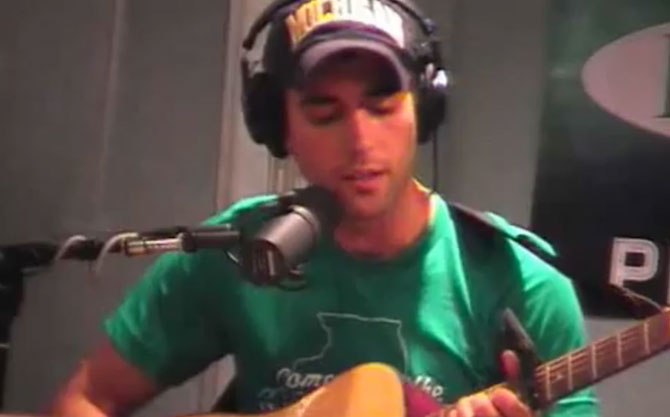
Sufjan Stevens’ recent performance on Morning Becomes Eclectic is now available in streaming video. It’s a fantastic set.
Yesterday I made the mistake of pulling Christopher Bigsby’s latest book from the library shelf. Arthur Miller: A Critical Study (2005) will, I assume, be Bigsby’s final statement on Miller.
That Mailer’s opinion of the corporate executive echoes exactly D.J. Jethroe’s is no coincidence, for this selective amnesia — this sense that all is permissible so long as it is state-sanctioned, to the benefit of American markets, and hidden from plain view — is, according to Mailer, precisely why America was in Vietnam.
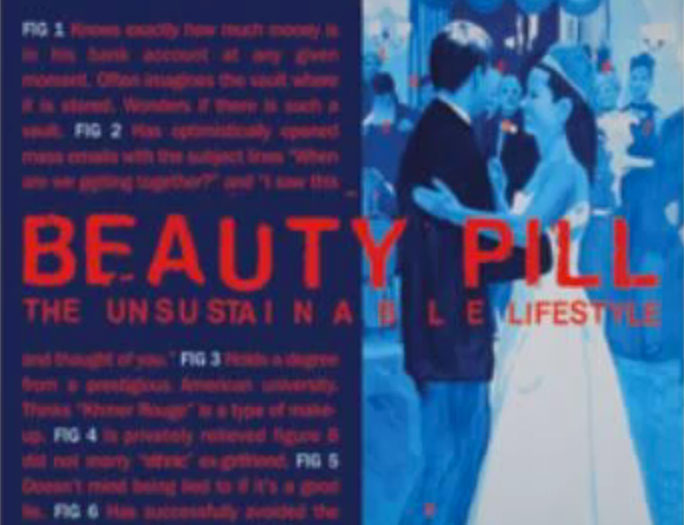
In a relatively short time Beauty Pill has gone through a few members, and with a couple singers and songwriters in the band there is a surprising amount of variety on display. The Song of the Moment, “Goodnight For Real” is representative only in that it features clever lyrics, solid playing (including some fun synth parts), and a really catchy chorus.
What so impressed me about the episode is that, even during the final, most emotionally-rich scenes, Lowe never slips into scene-stealing TV actor mode.
I got the sense that this guy was accustomed to being the most knowledgeable (or at least the loudest) guy in the room, so I was content to let him talk until he ran out of steam, hoping all the while that Joanna would wander back in our direction or that a meteor would destroy the apartment complex across the street. Anything that would give us an excuse to change the subject.
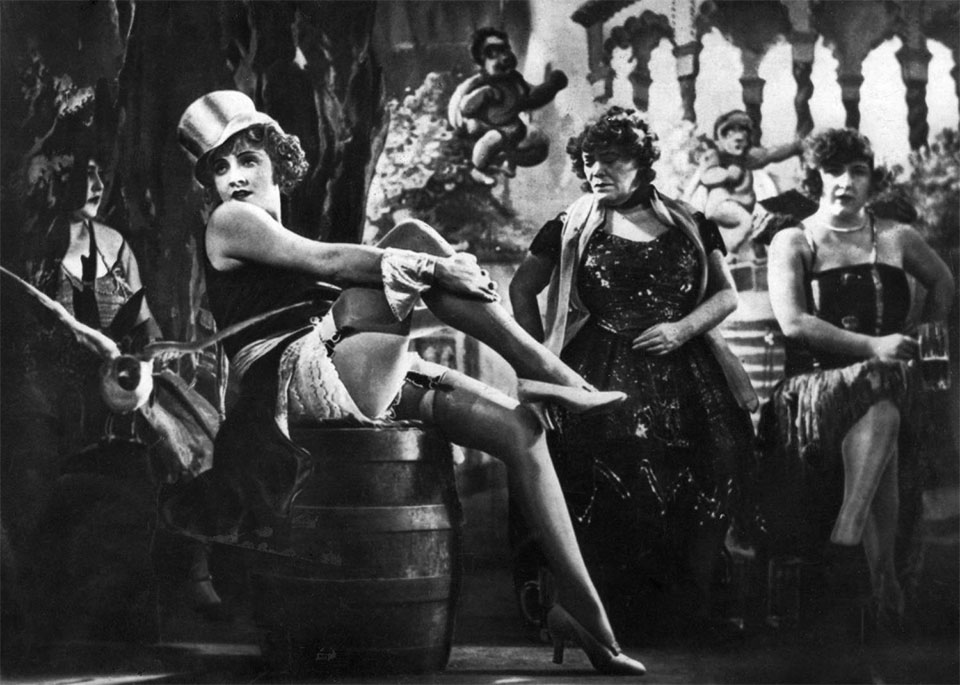
In a deliberate effort to beef up my cinephile cred, lately I’ve been loading my GreenCine queue with selections from the list of 1,000 Greatest Films compiled by the folks at They Shoot Pictures.
“Well, we don’t know what’s happening exactly, but it must be big. Speculate away!”
TIFF has released its new poster.
Nothing like a film meme to get the desiccated, blog-writing juices flowing again.
Many of us who opposed the war did so, in part, because we feared that destabilizing Iraq would provoke a civil war that would prove a humanitarian crisis worse than even Saddam’s regime. I wonder how American sentiment toward our role in Iraq would change if we admitted that the civil war has already begun?
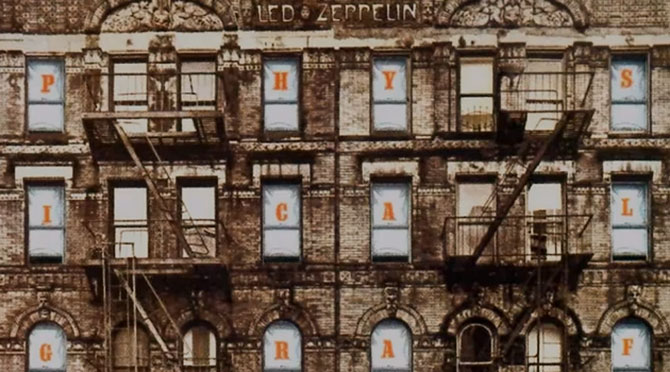
I’m afraid that Long Pauses is fast becoming an outlet for end-of-the-week rambles, written while I drink away a Friday afternoon. The following is an incomplete list of topics I would cover at much greater length and with much greater insight given the time, energy, and inclination.
“Although he refused the mechanical determinism of the unthinking Marxist left, he created in his greatest play a drama in which it is impossible to avoid thinking about economics–money–in any attempt to render coherent the human tragedy unfolding before you.”

Some recent viewings: Notre Musique, The Best Years of Our Lives, Sunrise, Howard Zinn: You Can’t Be Neutral on a Moving Train.
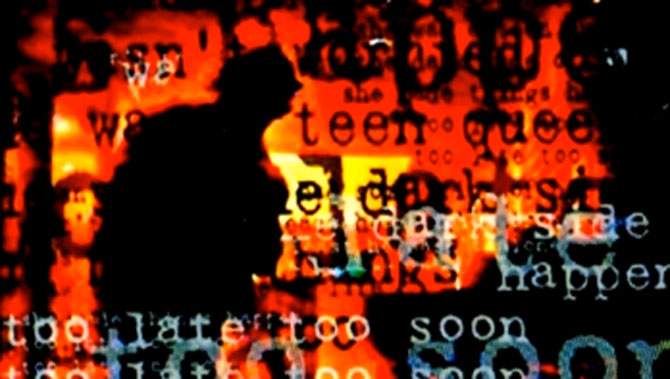
The new Song of the Moment, Neil Young’s “Safeway Cart,” scores a scene in which the Legionnaires march through a rocky desert, one of their many meaningless exercises in the film. It plays like a dirge and is one of Beau Travail’s few explicit references to the Christian allegory at play.
Never walk through the kitchen appliance aisle at Target when you’re craving coffee and have a credit card.
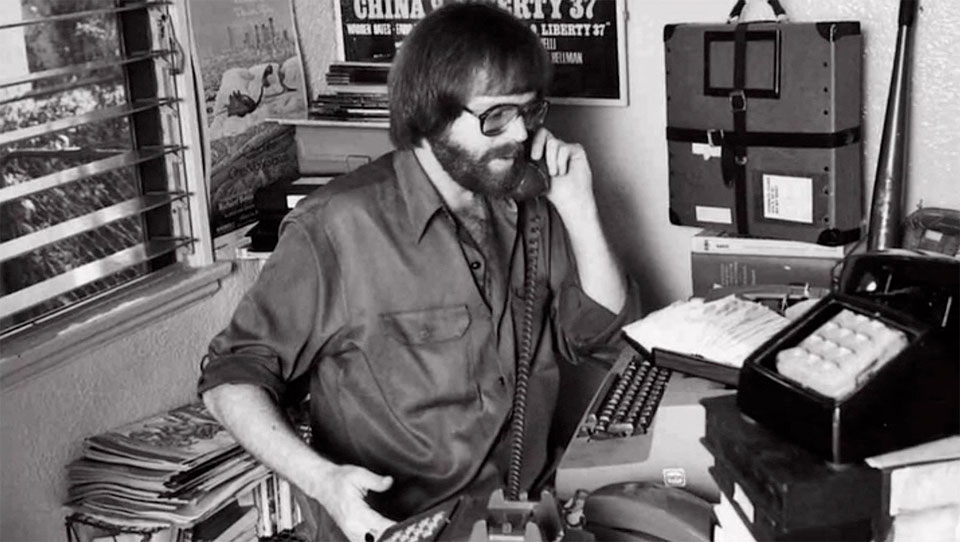
How would the tone of the film change, for example, had she included reports from the crime scene or interviews with his wife’s surviving family? Instead, we are offered only one quick glance at a photo of the woman who later would be brutally murdered, and a few fond remembrances of her from Harvey’s friends.
So, this is kind of exciting. My copy of Philip Roth: New Perspectives on an American Author just arrived, hot off the proverbial press. My article, “The ‘Written World’ of Philip Roth’s Nonfiction,” is the 17th and final chapter in what I believe is the first book-length study of Roth’s entire body of work, up to and including The Plot Against America. Pretty cool. My first book chapter.
Karen has stumbled upon a wonderful discovery. If you take a magazine, remove all of the stuff that is designed to make you spend money (between 40% and 100% of the content of most mags), and replace that crap with stories, essays, interviews, photos, and jaw-dropping design, you end up with something like art.
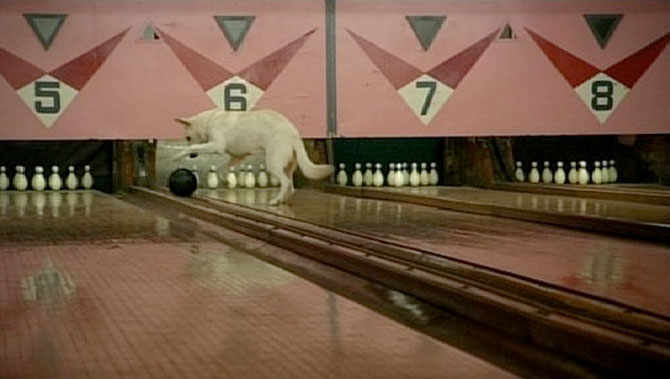
San Francisco, in case this hasn’t been said often enough, is a great city, and I spent most of my time there doing all of the touristy things one is obligated to do during a first visit — riding cable cars, walking through Muir Woods, taking pictures of the Golden Gate bridge, browsing through record and book shops, and eating to the point of exhaustion.
A few interesting snippets from part 1 of Jonathan Hourigan’s interview with Tim Cawkwell, author of The Filmgoer’s Guide To God. . .

“Missing” won Song of the Moment honors in a close race with “Black Tambourine” and “Hell Yes,” both of which, it must be said, are even more ass-shaking than “Missing” but not quite as perfect. All three sound even better in multi-channel.
We seem to be marching at a dizzying clip toward the fusion of media, and discs like Play and Guero offer us a taste of the media-gumbo that is likely to emerge. It’s fun to imagine what effect this might have on our visual literacy. Peter Gabriel brings artists like Robert LePage into our homes, and D-Fuse gives us art house abstraction.
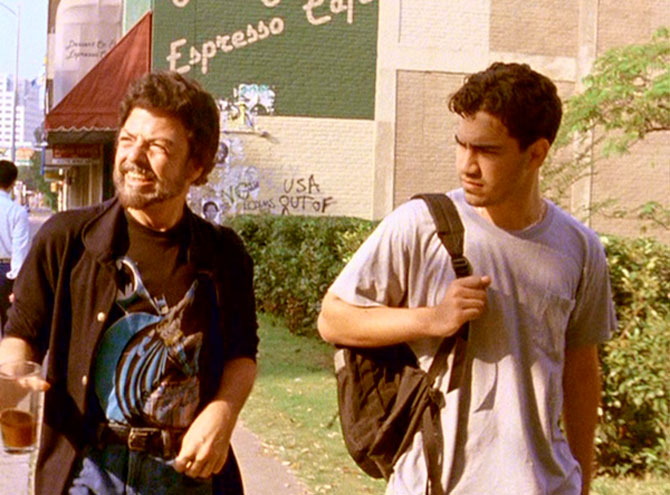
Linklater, perhaps more than any other contemporary filmmaker, is alive to the potential and the basic human value of the men and women who walk in and out of his films. And he seems to have a particular fondness for the folks who live on the margins, whether by choice or necessity.
This a blog-length response to a book-length subject, but is it possible to underestimate how radically our relationship to cinema has been changed by technology in the last 8 years?